Porrione74
The sources of Siena
Water masterpieces

In a city built on three steep hills and far from major rivers, the water supply was for centuries an epic challenge, overcome thanks to an ingenious system of which the Monumental Fountains are the finest proof. These structures were not simple tanks, but true civic monuments, hubs of the social and economic life of Siena’s districts.
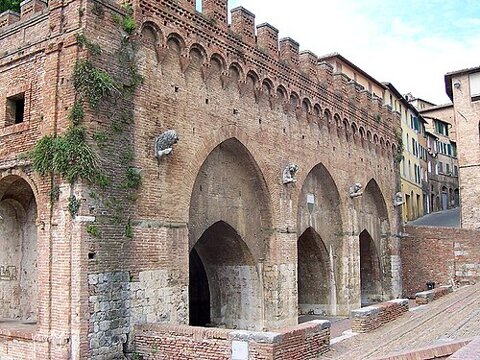
The queen of the fountains is undoubtedly Fontebranda, located in the territory of the Contrada dell'Oca. Mentioned even by Dante Alighieri in the Divine Comedy, this imposing Gothic structure with its three large pointed arches supplied water not only to citizens, but also to the many tanners’ and weavers’ workshops that thrived in the valley. Not far away, the Fonte Gaia in Piazza del Campo marks the monumental endpoint of the Bottini: today we admire a 19th-century copy of Jacopo della Quercia’s original, yet its presence still symbolizes the joy (hence the name “Gaia”) with which the Sienese welcomed the arrival of water in the heart of the square in 1343.
Exploring the more hidden quarters, you discover treasures like the Fonte Nuova d'Ovile, with its elegant Gothic lines, or the Fonte di Pescaia, which today houses the Water Museum. Each fountain was strictly arranged into three basins: the first for drinking use, the second for watering animals, and the third for washing clothes.
Visiting Siena’s Fountains means following a cool, evocative route, away from the main tourist flows, to discover the industrious soul of a city that knew how to turn a vital need into a collective work of art.
curiosity
the advice
ATTRACTION
The Water Museum Located above the rooms of the Fonte di Pescaia, this multimedia museum is perfect for understanding how the incredible Bottini system works. Through videos and interactive models, you can "travel" underground and discover how the ancient Sienese managed to bring water into the city with a slope calculated to the millimeter. A fascinating educational visit for both adults and children.
The Three Basins Look closely at the structure of each fountain: you will always see three distinct levels. Medieval law was extremely strict: anyone who dirtied the first basin (intended for human use) with dirty clothes or animals was heavily fined. This division system made it possible to reuse the water for three different purposes, ensuring the city's hygiene and survival even during periods of drought.
The Fountain Walk Instead of following the main shopping streets, plan a “perimeter” walk by following the fountains. Starting from Fontebranda, go down toward Fonte Nuova d’Ovile and climb back up to the Fonte di Follonica. It’s a route that will take you into Siena’s greenest, quietest areas, giving you views of the walls and inner valleys that most tourists will never see.
Tourist Information
Accessibility: Almost all the fountains are outdoors and can be visited for free at any time of day. They are also evocatively lit at night.
Walking route: Watch out for slopes! The fountains are often located in the lowest parts of the city ("flat valleys"). Be ready for steep climbs to get back toward Piazza del Campo or the Duomo.
Drinking Water: Although the water from the monumental fountains is not considered drinkable today for hygiene reasons, the city is full of modern drinking fountains ("noses") with fresh, safe water: bring a refillable bottle.